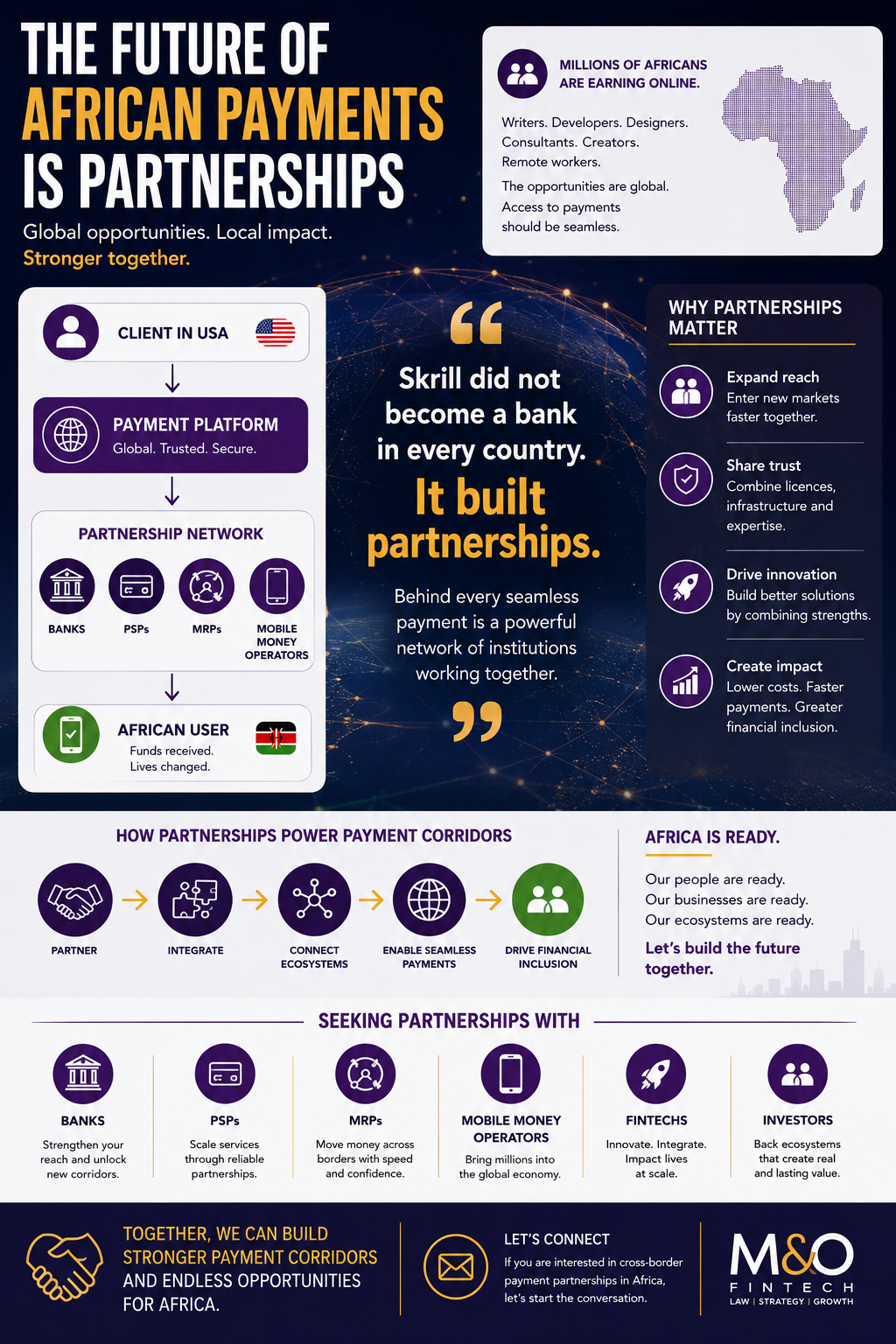
The Future of African Payments Is Partnerships
The most successful payment platforms in the world are not built on technology alone.
They are built on partnerships.
This may sound obvious today, but for many users, the infrastructure behind a payment transaction is invisible. A customer clicks "Send," a recipient receives funds, and the process appears effortless. What most people do not see is the complex network of institutions working behind the scenes to make that transaction possible.
Banks.
Payment Service Providers (PSPs).
Money Remittance Providers (MRPs).
Mobile Money Operators.
Technology Platforms.
Regulators.
Compliance Teams.
Together, these institutions form the backbone of modern payment ecosystems.
And nowhere is this more important than in Africa.
A Personal Reminder of the Power of Payment Partnerships
Many years ago, while studying law at university, I undertook online work for clients based primarily in the United States.
I wrote articles, blogs, research pieces and even contributed to books.
The work was available.
The challenge was getting paid.
A family member introduced me to Skrill, a platform that allowed me to receive payments from overseas clients. The process felt remarkably simple. A client in another country would send payment, the funds would be converted into Kenyan Shillings and eventually become accessible through M-Pesa.
At the time, I never stopped to think about how it worked.
Years later, as a fintech lawyer advising payment companies, banks and fintech startups across Africa, I revisited that experience from a different perspective.
What I once thought was a payment platform was actually a payment ecosystem.
The platform itself was only one part of the solution.
The real solution was partnerships.
Skrill Did Not Become a Bank in Every Country
One of the most important lessons for fintech founders is that successful payment businesses rarely begin by obtaining licences in every market they intend to serve.
Instead, they build strategic partnerships.
A typical payment ecosystem may involve:
- A payment platform providing the technology.
- Banks facilitating settlement and liquidity.
- PSPs processing transactions.
- MRPs facilitating cross-border transfers.
- Mobile Money Operators enabling local access.
- Regulators providing oversight and consumer protection.
Through these partnerships, payment companies can create seamless experiences for users while remaining compliant with local laws and regulations.
In many respects, partnerships are the infrastructure behind innovation.
Why Partnerships Matter in African Payments
Africa remains one of the most exciting payment markets in the world.
The continent is home to:
- Millions of freelancers.
- Growing digital economies.
- Expanding e-commerce markets.
- Rapid mobile money adoption.
- Increasing cross-border trade.
However, payment fragmentation remains a challenge.
Different currencies.
Different regulatory frameworks.
Different settlement systems.
Different licensing requirements.
For payment businesses seeking to scale across Africa, partnerships provide a practical solution.
1. Faster Market Entry
Partnering with existing licensed institutions allows payment businesses to launch services more efficiently while building transaction volumes and market presence.
2. Regulatory Efficiency
Rather than pursuing multiple licences simultaneously, businesses can initially leverage regulated partners while developing long-term licensing strategies.
3. Expanded Geographic Reach
Partnerships enable payment companies to access new jurisdictions and customer segments without building every component internally.
4. Reduced Costs
Shared infrastructure often reduces operational and settlement costs while improving transaction speed.
5. Enhanced Financial Inclusion
Most importantly, partnerships allow more people to participate in the global economy.
Building Payment Corridors Through Partnerships
The future of African payments lies in the creation of stronger payment corridors.
A payment corridor refers to a structured pathway through which funds can move between two or more markets.
For example:
- Kenya – Uganda
- Kenya – Tanzania
- Kenya – Rwanda
- Kenya – DRC
- Kenya – South Sudan
Creating these corridors requires collaboration between multiple stakeholders.
A fintech may provide the technology.
A bank may provide settlement infrastructure.
A PSP may facilitate processing.
A mobile money operator may provide local access.
An MRP may facilitate cross-border transfers.
When these institutions work together, seamless payment experiences become possible.
The Opportunity for Banks, PSPs, MRPs and Fintechs
The growth of Africa's digital economy presents significant opportunities for collaboration.
Today, millions of Africans earn income online as:
- Writers
- Developers
- Designers
- Consultants
- Virtual Assistants
- Content Creators
- Remote Workers
The demand for efficient payment solutions continues to increase.
This presents opportunities for:
Banks
To extend reach and participate in emerging payment ecosystems.
Payment Service Providers (PSPs)
To scale services through regional partnerships.
Money Remittance Providers (MRPs)
To create efficient cross-border payment corridors.
Mobile Money Operators
To deepen financial inclusion and customer access.
Fintechs
To innovate and build scalable payment solutions.
Investors
To support infrastructure that enables long-term growth.
The Future of African Payments
The future of African payments will not be determined solely by who has the most sophisticated technology.
Nor will it be determined by who obtains the most licences.
It will be determined by who builds the strongest partnerships.
The payment platforms that succeed across Africa will be those that understand how to bring together banks, PSPs, MRPs, mobile money operators, regulators and technology providers into a single ecosystem.
Because behind every successful payment is a partnership.
And behind every partnership is an opportunity.
For businesses.
For consumers.
For financial inclusion.
And for Africa.
Interested in building payment corridors or exploring partnership opportunities across Africa?
Contact us to discuss how strategic partnerships can accelerate your growth and unlock new markets across the continent.