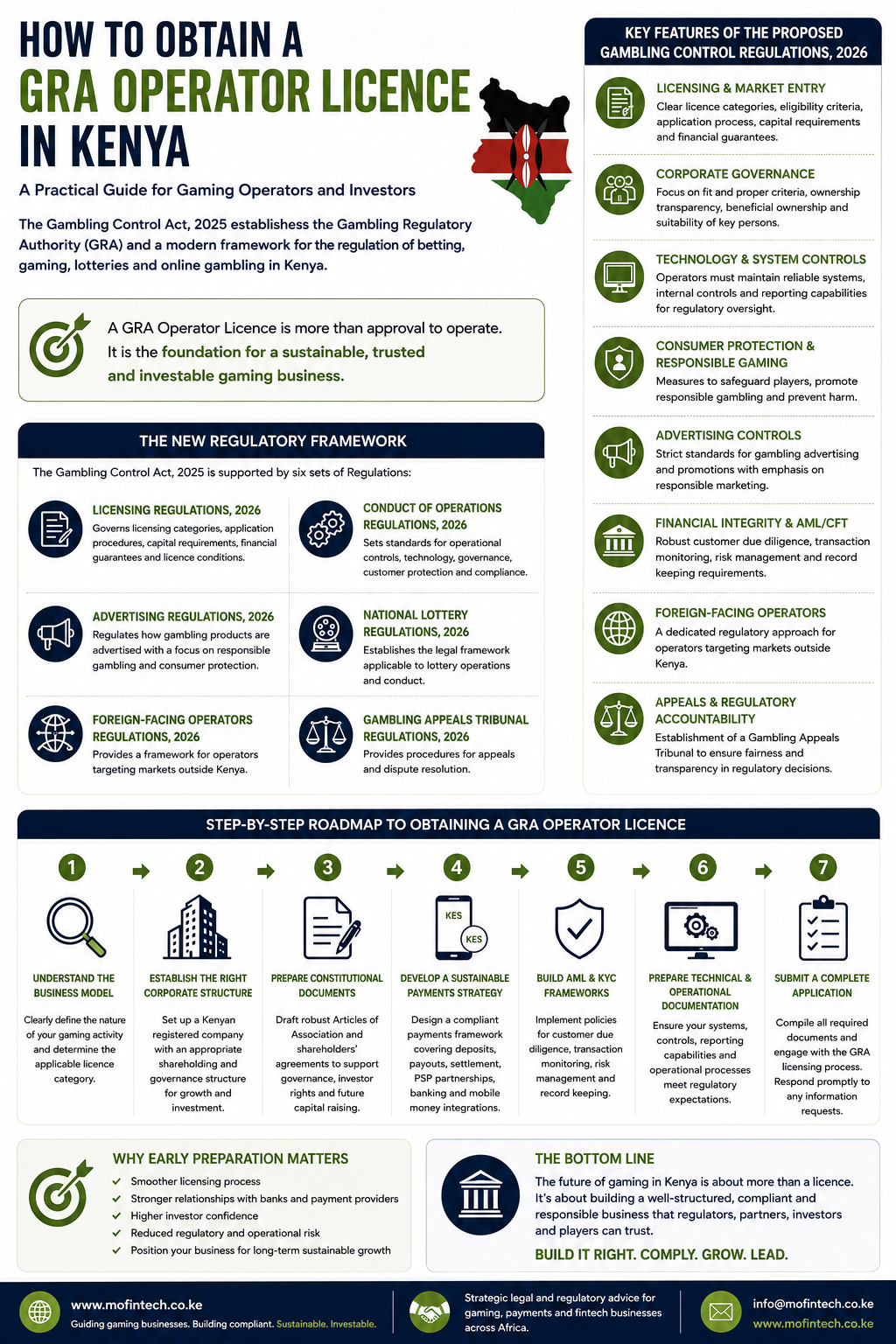
How to Obtain a GRA Operator Licence in Kenya: A Practical Guide for Gaming Operators and Investors
The enactment of the Gambling Control Act, 2025, and the publication of the proposed Gambling Control Regulations, 2026 represent the most significant reforms to the sector in decades. The new framework is intended to modernize the regulation of betting, gaming, lotteries and online gambling while strengthening consumer protection, financial integrity and responsible gaming.
For investors and operators, one question is becoming increasingly common:
How do you obtain a GRA Operator Licence?
The answer, however, extends beyond completing an application form. The new framework suggests that successful operators will need to demonstrate sound corporate governance, operational capability, financial integrity and compliance systems before entering the market.
Understanding the New Gambling Regulatory Framework
The Gambling Control Act, 2025 establishes the Gambling Regulatory Authority (GRA) as the principal regulator of gambling activities in Kenya.
To operationalize the Act, the GRA has proposed several sets of Regulations that collectively govern the gaming ecosystem.
The Gambling Control (Licensing) Regulations, 2026
The Licensing Regulations establish the legal framework for market entry and deal with:
- Licence categories;
- Licensing procedures;
- Eligibility requirements;
- Financial guarantees;
- Licensing conditions;
- Renewal, suspension and revocation of licences.
These Regulations effectively determine who can participate in Kenya's gaming industry and under what conditions.
The Gambling Control (Conduct of Gambling Operations) Regulations, 2026
These Regulations focus on the day-to-day operation of gaming businesses and introduce standards relating to:
- Operational controls;
- Technology systems;
- Internal governance;
- Customer protection;
- Compliance monitoring.
The Regulations reflect the increasing expectation that gaming businesses should maintain robust operational systems.
The Gambling Control (Advertising) Regulations, 2026
Advertising has become a significant regulatory issue globally. The proposed framework seeks to regulate gambling advertisements and promote responsible gambling practices while protecting vulnerable members of society.
The Gambling Control (National Lottery) Regulations, 2026
These Regulations establish the legal framework applicable to lottery operations and the conduct of national lottery activities.
The Gambling Control (Foreign-Facing Operators) Regulations, 2026
These Regulations recognise the increasingly international nature of gaming and seek to provide a framework for operators targeting markets outside Kenya.
This is particularly relevant for international investors considering Kenya as a regional hub.
The Gambling Control (Gambling Appeals Tribunal) Regulations, 2026
The Appeals Tribunal Regulations establish procedures for reviewing and challenging regulatory decisions, thereby promoting fairness and transparency within the licensing process.
Key Features of the Proposed Regulations
A review of the proposed Regulations reveals several important themes.
Greater Corporate Governance
The framework places considerable emphasis on ownership structures, beneficial ownership transparency and the suitability of directors and key persons.
Enhanced Consumer Protection
The Regulations seek to strengthen responsible gambling measures and improve safeguards for consumers.
Stronger Technology Oversight
Operators are expected to maintain adequate systems capable of supporting regulatory supervision and operational integrity.
Increased Focus on Financial Integrity
The framework encourages operators to implement appropriate internal controls, risk management procedures and customer due diligence measures.
Regulation of Advertising
Marketing activities will increasingly be subject to regulatory oversight.
Cross-Border Operations
The introduction of Foreign-Facing Operator Regulations demonstrates an appreciation of the international nature of the gaming industry.
Collectively, these developments indicate that the future of gaming regulation in Kenya extends beyond licensing and into the broader areas of governance, operations and compliance.
A Practical Roadmap for Obtaining a GRA Operator Licence
Step 1: Understand the Business Model
Before beginning the licensing process, an operator should clearly define the nature of its business.
Different gambling activities may attract different licensing requirements. A clear understanding of the proposed business model is therefore essential.
Step 2: Establish the Appropriate Corporate Structure
A licensing application should rest on a strong legal foundation.
Key considerations include:
- Shareholding structure;
- Voting rights;
- Corporate governance;
- Founder protections;
- Future investment strategy.
A properly structured company is generally better positioned for growth and future investment.
Step 3: Prepare Constitutional Documents
The Articles of Association should be tailored to the business rather than relying solely on standard templates.
The constitutional documents should anticipate:
- Future investors;
- New classes of shares;
- Founder voting rights;
- Reserved matters;
- Governance mechanisms;
- Deadlock resolution.
Step 4: Develop a Sustainable Payments Strategy
One of the most overlooked aspects of gaming businesses is the supporting payment infrastructure.
An operator should carefully consider:
- Banking relationships;
- Mobile money integration;
- Payment service provider partnerships;
- Customer deposits;
- Customer payouts;
- Settlement arrangements.
Many operational challenges experienced by gaming businesses arise not from the platform itself but from weaknesses in the supporting commercial structure.
Step 5: Build AML and KYC Frameworks
Modern gaming businesses increasingly operate within a financial regulatory environment.
Appropriate policies should address:
- Customer due diligence;
- Transaction monitoring;
- Risk management;
- Record keeping;
- Internal controls.
Strong compliance systems often improve relationships with regulators, financial institutions and strategic partners.
Step 6: Prepare Technical and Operational Documentation
The proposed Regulations indicate a growing emphasis on technology systems and operational resilience.
Operators should ensure that their internal systems are capable of supporting regulatory oversight.
Step 7: Prepare and Submit the Application
Once the legal, operational and compliance structures are in place, the operator can prepare the formal application and engage with the GRA licensing process.
A properly prepared application is often more efficient than attempting to resolve structural issues during regulatory review.
Why Early Preparation Matters
The Gambling Control Act, 2025 represents more than a change in legislation.
It reflects a broader shift in regulatory philosophy.
The emphasis is increasingly moving towards:
- Good governance;
- Consumer protection;
- Responsible gaming;
- Financial integrity;
- Technology oversight;
- Sustainable industry growth.
Businesses that address these issues at the outset are likely to be better positioned to attract banking partners, payment service providers, strategic investors and long-term commercial opportunities.
Conclusion
The future of gaming regulation in Kenya is not simply about obtaining a licence. It is about building an enterprise capable of operating within a modern and increasingly sophisticated regulatory environment.
The Gambling Control Act, 2025 and the proposed Gambling Control Regulations, 2026 suggest that licensing, governance, payments, technology and compliance are becoming increasingly interconnected.
The operators that recognise this shift early and structure their businesses accordingly will likely enjoy a significant competitive advantage.
Because in today's gaming industry, the strongest businesses are not merely licensed.
They are built for regulation from the very beginning.
#GRAOperatorLicence #GamingLicenceKenya #GamblingControlAct2025 #GamblingControlRegulations2026 #GamblingRegulatoryAuthority #OnlineBettingLicenceKenya #CasinoLicenceKenya #iGamingKenya #GamingLawKenya #GamingCompliance #FintechLaw #PaymentsLaw #AfricaGaming #KenyaGaming #RegulatoryCompliance #CorporateGovernance